How many kgs is your pile? That’s the question every scrap seller will ask you. If you’re ever wondering ‘how much does my scrap weigh?’ then you can easily get a figure before you even get in touch with H&Z Scrap Metal. All you need to do is weigh it on a bathroom scale for a couple of minutes. You don’t need an exact figure, just a fairly accurate estimate to work on the job.
The First Question Every Scrap Yard Asks
The very first question you’ll be asked at any scrap yard is “How much do you have?” It’s a very straightforward question and most people have no idea what the weight of their scrap actually is. Sheds and backyards are full of metal which just accumulates week on week. You have no idea whether that pile of guttering is 50kg or 200kg. You have no idea whether that pile at the back of the garage is two car loads or one trailer load. We get that question in every inquiry and it’s easy enough to help you with the answer. There are three ways of working out scrap weight, a comparison of steel and aluminium and some safety advice to bear in mind prior to loading your vehicle.
Why Weight Matters Before You Call
Scrap job decisions are weight based. That tells you whether you’re going to take the metal to the yard yourself or have a bin delivered. It tells you what vehicle/trailer you need, whether you’re doing it alone or need a helper and how long the job will take. Scrap metal is also paid for by weight. All the scales at the yard are certified, and the figure on those scales is the final weight. That said, a sensible estimate will help you avoid making a trip with too much or too little and will let us give you useful advice on the first call.
Steel vs Aluminium: How Much Does Scrap Metal Weigh?
Understanding density allows you to judge weight. Density is mass per unit volume, so two piles of the same size can end up with very different weights depending on the metal.
- Solid steel: about 7,850 kg/m³ (7.85 tonnes per cubic metre)
- Cast iron: lighter, at about 7.2 tonnes/m³
- Copper: about 9 tonnes/m³
- Brass: about 8.4 to 8.7 tonnes/m³
- Aluminium: about 2.7 tonnes/m³, roughly a third of the weight of steel for the same volume
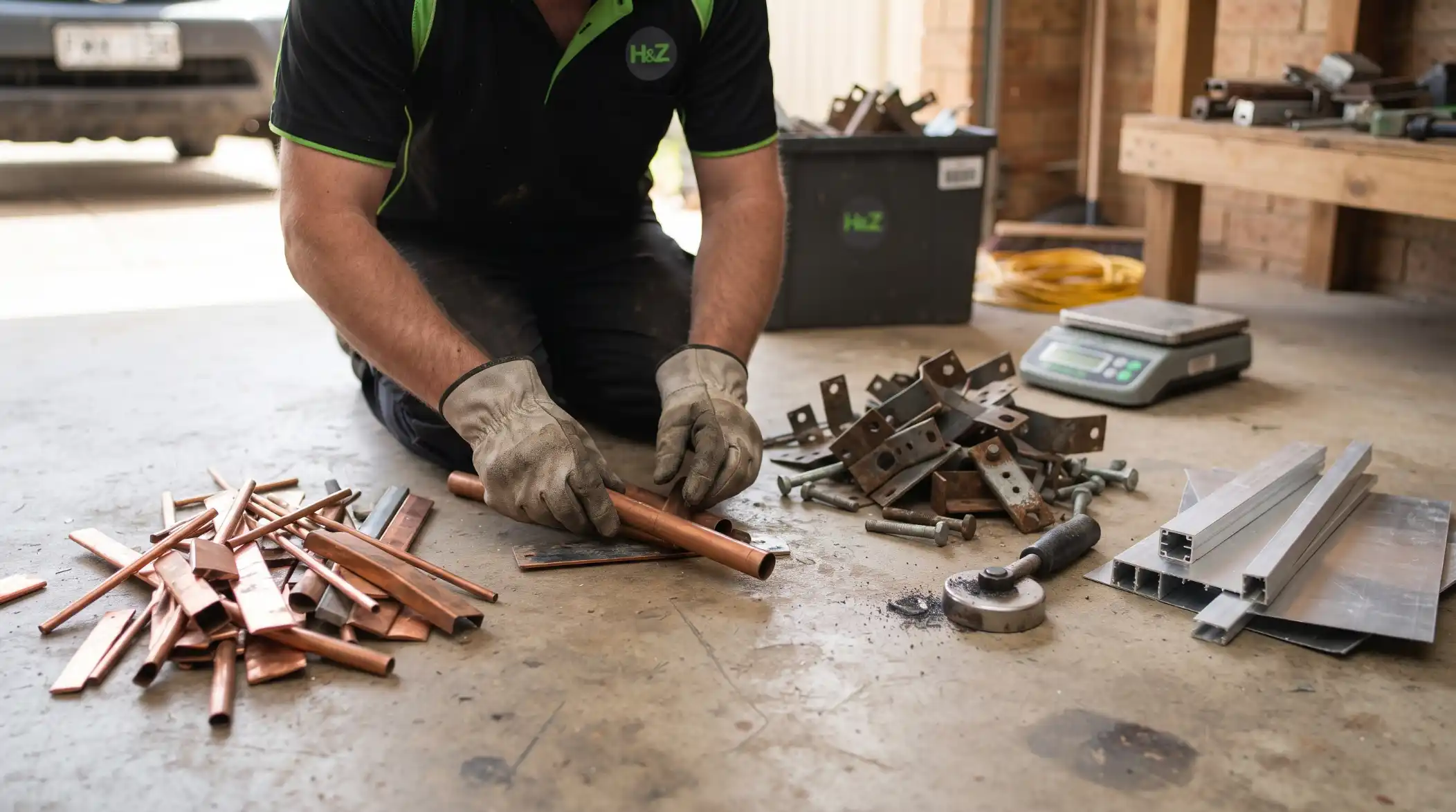
These are the figures for metal with no gaps. A loose scrap pile will have air in the gaps so one cubic metre of scrap contains a hell of a lot less metal than one cubic metre of solid metal. That’s what’s meant by bulk density. It can vary absolutely massively depending on the shapes and sizes of the pieces and how tightly they’re packed together. Mustn’t confuse the two concepts: metal has a density and so does the pile. This explains a few of the surprises. A small pile of steel offcuts or a single piece of cast iron can be absolutely heavy, whereas a pile of aluminium window frames may be very bulky but extremely light to move. The first thing to do when you’re trying to work out a weight is to establish what type of metal you’re dealing with.
Use a Magnet to Identify Your Metal
If you’re not quite sure what you’ve got, start with a magnet. If it sticks then the metal is almost certainly iron or steel and therefore it’ll be heavy. If it doesn’t stick then it could be aluminium, copper, brass or some other non-ferrous metal. Stainless steel needs a bit of care. A number of the grades (304, 316 and 430 to name but a few) are non-magnetic or only very weakly magnetic. Some grades are magnetic. A magnet will be of no assistance in identifying stainless steel. If it doesn’t stick then look at the colour, the weight, the texture and the surface finish and let us know all of those details when you get in touch.
Method 1: Weigh a Sample and Multiply
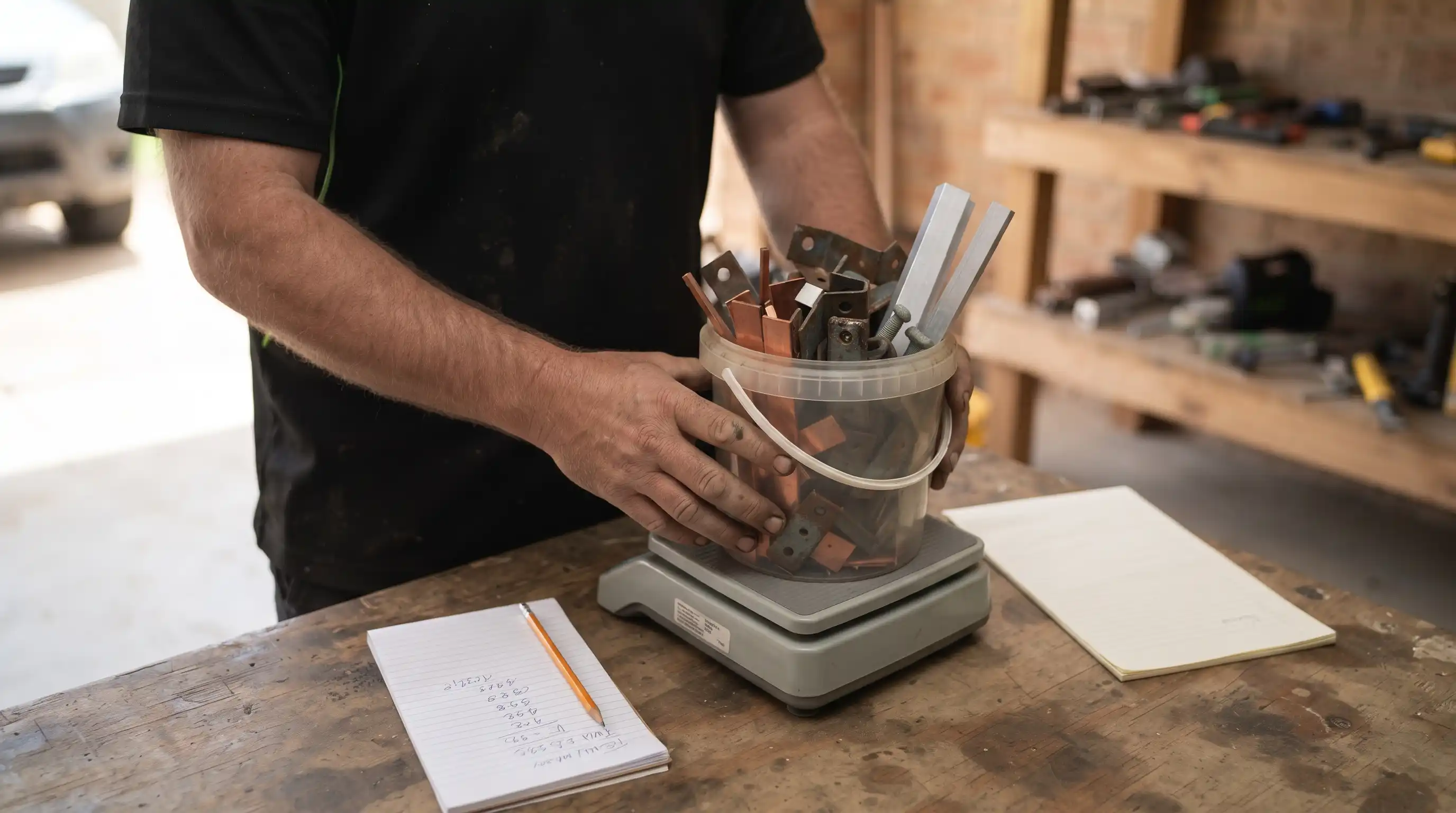
The most accurate way of working out scrap weight is to weigh a sample and then multiply. That’s the best way to do it if you’ve got a pile of one type of metal (a pile of steel offcuts, fencing, pipe etc). Use a bucket, crate or sturdy laundry basket. Take a sample from the pile and weigh it in one of two ways:
- Simply put the container directly onto the bathroom scale and read the weight. Make sure the scale is stable and suitable for the load.
- Weigh yourself, then weigh yourself again with the container in your hands. Work out the difference.
Always check the scale’s weight limit. Don’t lift anything you can’t safely lift. Next work out how many containers you’d need to hold the whole pile. Take the example of 20 buckets full of steel. If each bucket is 15kg, your pile is going to be roughly 300kg. It’s not exact, it’s just a hell of a lot more accurate than an eye estimate. With a bit of practice you’ll get a feel for how much each type of bucket weighs.
Method 2: Count the Items and Weigh One
Some scrap will come as complete items rather than individual pieces (e.g., an old ladder, a wheelbarrow, a bed frame, lengths of fencing, a filing cabinet, etc.). In that case, you’d just weigh one and multiply by the number you have. If you’ve got ten steel fence panels then just weigh one and multiply that by 10. If you’ve got 12 aluminium frames then weigh two or three of them, take the average and multiply that by 12. For appliances, use typical weights, which vary by brand and model:
- Washing machine: 50 to 80 kg
- Household fridge: 40 to 100 kg or more
- Split-system air conditioner: 25 to 50 kg
- Car: roughly 1 to 2 tonnes
Check the rating plate (or do a web search using the model number) for a more precise figure.
Take Care With Fridges and Air Conditioners
Refrigerators, freezers and air conditioners all contain gas and compressor oil. You must never cut, drill, crush or otherwise damage these units and you must never disconnect or damage the pipework. The refrigerant must be recovered by a qualified technician as it is both a health and environmental hazard. Some of the units may still contain flammable refrigerants or oils. If you can, keep the appliances upright. Get someone to help you lift them. Let us know when you call H&Z Scrap Metal, and we can advise you on how to handle them.
Method 3: Estimate by Volume
If it’s a large pile or of an irregular shape you can work out its weight from its volume. Work out the volume of the pile in m³ (length x width x height) and that will tell you the size of the pile rather than the amount of metal in it. Bulk density is the key. Most scrap is full of air (the voids between the pieces in a tangle of sheet metal, mesh, wire and all sorts of mixed steel offcuts). One cubic metre of scrap will be much lighter than one cubic metre of solid steel. Light sheet and coiled wire pack very loosely and are therefore a lot lighter than heavy plate and solid bar. If you take the volume of the pile and multiply it by the weight of steel, you’re going to be way off. That method is best used in conjunction with Method 1. Take a sample, work out how many samples would fit into the pile and multiply. That accounts for air space and gives you a far more accurate figure than any formula.
Check Your Vehicle’s Limits Before You Load
Metal is heavy. It’s easy to overload a vehicle or trailer. Overloading can damage your vehicle, affect your steering and braking, and may be an offence. Don’t assume a small load is OK. Steel in particular can exceed the limit of your vehicle without taking up much space on the tray. Once you have an estimated weight, check your vehicle’s limits. There are two figures that are important here. Gross Vehicle Mass (GVM) is the maximum allowable weight of the loaded vehicle (i.e. the vehicle itself, the load, the passengers and the fuel). Payload is the amount of load your vehicle can carry (GVM less the weight of the vehicle, the passengers and the fuel). These figures will be on your compliance plate or in your owner’s manual. If you’re towing, then the compliance plate on the trailer will show its Aggregate Trailer Mass (ATM). Your vehicle will need to be capable of towing that. If your estimate is at the limit, you’ll need to do two trips or contact us about a pick-up.
Stay Safe When Loading and Unloading
Safety applies to you as much as it does to the vehicle. Scrap metal is heavy, sharp, and awkward. Cut-resistant work gloves, boots (steel-capped if possible), long sleeves, and eye protection are a must. When lifting, bend your knees and ask for a hand with anything you can’t comfortably carry. Spread the weight out, keep the heavy stuff low and as close to the centre as possible, and secure everything down so it doesn’t shift whilst you’re driving.
Common Mistakes When Estimating Scrap Weight
We see the same errors time and again:
- Going on size alone. Work out what metal you’re dealing with first. A big pile of aluminium could well end up weighing less than a smaller pile of steel.
- Counting things that aren’t metal (plastic handles, rubber, glass, timber, concrete etc). They all add weight and bulk, and they’re just not paid for as metal. If it’s safe to do so, take out what you can and allow for the rest.
- Going on volume alone. If you take volume and multiply that by the weight of solid metal, you’re completely ignoring the air space in the loose scrap. That will certainly give you a weight that’s too high.
- Going with one guess. Make two estimates (e.g., by sample weight and by counting the items) and compare them. If they’re close, you can be fairly confident. If they’re very different, then check your numbers again.
- Overthinking it. Any sensible range is fine, as the yard scales will give you the exact figure.
What to Tell Us When You Call H&Z Scrap Metal
A few details help us advise you quickly:
- The type of metal: e.g., steel fencing, copper pipe, aluminium window frames.
- Your best estimate of the weight and how you arrived at it: a weighed sample, a count of the items, or a pretty rough guess.
- Where the scrap is and how easy it is to access: for example, in the garage, in the backyard, or alongside the house.
- Anything heavy or large (e.g. a car, a machine, an appliance) and anything that contains fluid, electricity, or pressure.
- Photos if you can. They’re a help.
Having that information, we can advise you as to whether you should drop it off or have it picked up and what to expect on the day.
When You Bring Your Metal In
When you bring your metal to H&Z Scrap Metal, it gets sorted, weighed on certified scales, and then assessed. The final weight is the figure you’re paid on. If your initial estimate was a bit high or a bit low, that’s absolutely fine. Your first estimate is just a guide, and with a bit of experience it becomes a lot easier. Just write down the weight and compare it to your estimate. Next time, you’ll have a much better feel for what a bucket, a bundle, or a boot-load of metal actually weighs.
Quick Tip: Use the Bucket Method
If you’ve got a pile of scrap and just want a quick weight, weigh one full bucket on the bathroom scale. Work out how many buckets the pile would fill and then adjust for the type of metal. That’s ten minutes or less. It takes the rather vague “I don’t know how much that is” and turns it into a number you can actually do something with. Keep that in mind. The density of the metal is different to the bulk density of a loose pile and size doesn’t mean anything in terms of weight. The only real measure is the yard’s scales. An estimate is all you need to plan the job. Not quite sure how much you’ve got? Just give H&Z Scrap Metal a call with your estimate and a few photos and we’ll help you work out the safest and easiest way to get your metal from your property to the weigh-in.